

Aug 24, 2026
How Dynamic Spine Offloading™ Works for Spine pain
If you’ve searched for “disc bulge treatment without surgery in Bengaluru” or “best physiotherapy for nerve pain in the back”, you’ve most likely encountered many options and a lot of confusing terminology. This guide cuts through the noise. It explains in plain, evidence-backed language exactly what Dynamic Spine Offloading™ (DSO) is, how it works at the level of your anatomy, and who it is designed for.
Dynamic Spine Offloading™ is the proprietary name used by Movementology Clinics for motorised, computer-controlled, cyclical mechanical treatment of the cervical (neck) and lumbar (lower back) spine. It is delivered using the Orthotrac Lasedia- a Japanese-engineered medical device designed specifically for this application.
This is not basic traction. It is a systematised, evidence-informed, clinician-supervised rehabilitation approach that has helped hundreds of patients at our HSR Layout, Koramangala, and Whitefield clinics avoid spinal surgery and return to full function.
Q: What is Dynamic Spine Offloading and how does it work?
A: Dynamic Spine Offloading™ (DSO) is a computer-controlled, motorised physiotherapy treatment that applies a precise, cyclical pulling force to the spine while the patient lies in a supine (face-up) position. It temporarily reduces pressure inside the intervertebral discs and widens the exits through which spinal nerves pass (intervertebral foraminae). This reduces nerve compression and disc-related pain. DSO is delivered at Movementology Clinics using the Orthotrac Lasedia device, manufactured by OG Wellness, Japan.
Why Your Spine Is Under Pressure — And Why That Matters
The intervertebral disc sits between each pair of spinal vertebrae. It is the spine’s shock absorber, a tough outer ring (annulus fibrosus) enclosing a gel-like core (nucleus pulposus). Discs have no direct blood supply. They depend entirely on mechanical pressure change during movement to receive nutrients and expel waste.
When you sit for extended periods, particularly in a forward-flexed posture common in desk work, discs are compressed continuously. Over months and years, this leads to: disc height loss; reduced disc hydration; posterior disc bulging; narrowing of the foraminae (nerve exit channels); and facet joint overloading. These changes produce the pain, stiffness, and radiating nerve symptoms that bring most patients to our clinics.
Q: What conditions does Dynamic Spine Offloading treat?
A: DSO at Movementology Clinics is indicated for: cervical radiculopathy (neck pain with arm pain or tingling); lumbar radiculopathy (back pain with leg pain or sciatica); contained disc herniation or disc bulge; foraminal stenosis (narrowed nerve tunnel); degenerative disc disease; facet joint syndrome; and chronic mechanical neck or back pain. Each patient undergoes a clinical assessment to confirm suitability before DSO is prescribed.
The Four Mechanisms of DSO: What Happens Inside Your Spine
Mechanism 1: Intradiscal Pressure Reduction (The Mechanical Effect)
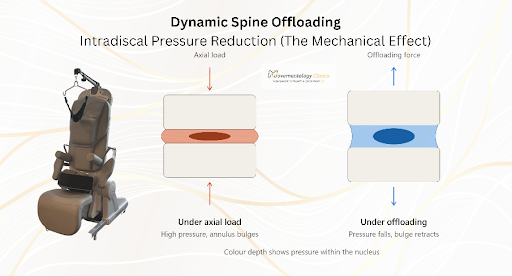
The cyclical tensile force applied during DSO creates a measurable, transient reduction in intradiscal pressure (IDP). Research by Nachemson and Elfstrom (1970) the foundational study on spinal load measurement established baseline IDP values across positions. Mechanical traction further reduces this pressure, creating conditions in which bulged disc material may partially retract and nerve root compression decreases.The intervertebral foramen (the bony tunnel through which spinal nerve roots exit the spine) widens by an estimated 1.5–3mm under traction load — clinically significant when the nerve root diameter itself is only 3–4mm.
Mechanism 2: Disc Nutrition Enhancement (The Pumping Effect)
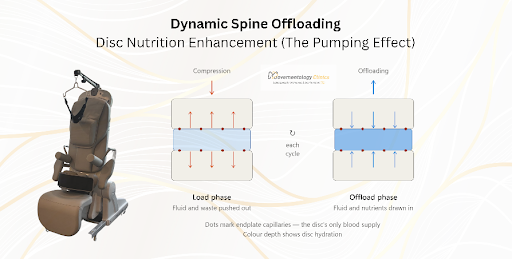
The load-hold-relax cycle of DSO creates a pumping action that drives fluid movement into and out of disc tissue which will improving the local biochemical environment for disc cells. This is sometimes (incorrectly) marketed by other providers as ‘disc rehydration therapy’. Movementology does not use this term, as the permanent clinical significance of this fluid exchange has not been definitively established in clinical trials. What is established is the mechanobiological benefit of cyclical load variation to avascular disc tissue.
Mechanism 3: Neurophysiological Pain Modulation (The Gate Control Effect)
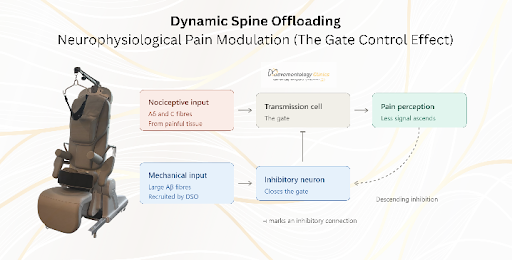
DSO stimulates large-diameter mechanoreceptive nerve fibres in the spinal tissues. This input inhibits nociceptive (pain) signal transmission at the spinal cord — the gate control mechanism first described by Melzack and Wall (1965). Additionally, rhythmic mechanical input reduces resting alpha motor neurone drive to paravertebral muscles, gradually breaking the pain-spasm-pain cycle that sustains chronic spinal pain.
Mechanism 4: Functional Restoration (The Clinical Outcome)
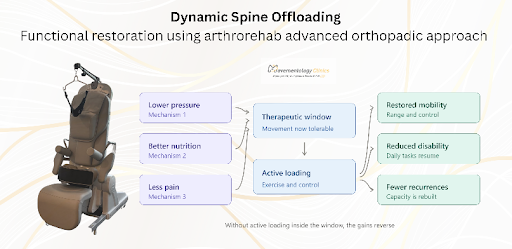
Over a structured course of DSO sessions — combined with exercise rehabilitation, manual therapy, and ergonomic correction, patients typically achieve: improved tolerance for sustained postures; restored spinal range of motion; return to occupational and recreational activities; and meaningful reduction in dependence on pain medication.
Why Supine Position Makes a Difference: The Orthotrac Lasedia Advantage
| Feature | Older Traction Devices | Orthotrac Lasedia (DSO at Movementology) |
|---|---|---|
| Patient position | Seated — muscles must work to support the head | Supine — gravity-assisted full muscle relaxation |
| Force control | Manual or basic mechanical | Computer servo-motor with real-time force feedback |
| Force profile | Static or simple intermittent | Programmable sinusoidal, trapezoidal, or stepped waveforms |
| Stabilisation | Minimal | Auto-Fit lateral pads + inflatable lumbar belt |
| Heat integration | Usually separate | Integrated thermotherapy unit |
| Safety | Manual stop | Dual-layer: patient cord + electronic emergency stop |
Q: Is Dynamic Spine Offloading the same as spinal decompression therapy?
A: No. Movementology Clinics deliberately does not use the term ‘spinal decompression therapy’ because it implies a surgical-level effect. Decompression in surgery means physically removing tissue pressing on nerves. DSO is a non-invasive treatment that transiently reduces disc pressure and widens foraminae. The term Dynamic Spine Offloading™ is more scientifically accurate, ethically appropriate, and patient-honest than spinal decompression.
Evidence Summary: What the Research Tells Us
| Condition | Evidence Level | Key Finding |
|---|---|---|
| Cervical radiculopathy | Level II evidence ( Moataz Mohamed El Semary 2024) | Cervical traction improved individuals’ Quality Life, depression, and insomnia |
| Cervical radiculopathy (CR) with cervicogenic headache (CGH) | Level II evidence (Anis Jellad 2024) | Mechanical intermittent cervical traction reduced CGH intensity and frequency, with benefits sustained for up to six months. |
| Lumbar disc herniation | Level I (Meta-Analysis: Wenxian Wang 2022) | The therapeutic effect of mechanical traction was better than conventional physical therapy. |
| Lumbar disc herniation | Level I (Meta-Analysis: Santhosh G. Thavarajasingam | Traction appears to be effective as part of conservative physiotherapy for lumbar disc herniation, particularly for reducing pain and improving functional outcomes |
| Cervical Radiculopathy | Level I (Meta-Analysis: Antonio Romeo 2018) | Mechanical traction is effective treatment for pain when added to various other physical therapy procedures in Cervical Radiculopathy |
What Our Patients in Bengaluru Say
★★★★★
” I am an Indian Army veteren aged 71 yrs. I came from Kolkata for physiotherapy of lower back pain at Movementology …….I was put on the Decompression machine, Japanese technology. An excellent machine I must say.. It took just 6 sessions on the machine under direct guidance of Shalvi. I became 100%fit.
All decompression & spasm gone. ………Whitefield unit is new and there are many new machines installed with trained staff. With my experience of decompression I would highly recommend anyone with spine related problem visit Dr Padhmanaman’s Movementology clinics , Whitefield, Bangalore once.“
— Col. Ashish Dutta, Bengaluru | Movementology Clinics, Whitefield | Google Review
Q: How many sessions of Dynamic Spine Offloading do I need?
A: Most patients at Movementology Clinics require 8–15 sessions of DSO, delivered 2–3 times per week. The exact number depends on the diagnosis (cervical or lumbar), severity, duration of symptoms, and response to treatment. Response is formally assessed using validated outcome measures at session 3, session 6, and discharge. Patients who show meaningful improvement by session 4 typically complete a full course of 10–12 sessions.
Spine Pain? Get Answers — Not Assumptions.
Book a Specialist DSO Assessment at Movementology Clinics. HSR Layout | Koramangala | Whitefield, Bengaluru
www.movementology.in