
Jul 24, 2026
The Machine That Made Astronauts Weightless Is Now Rebuilding Knees in Bengaluru
Isaac Newton didn’t invent gravity. He just noticed it. For three centuries, everything physiotherapy has ever done — every weight, every step, every squat — has happened entirely inside gravity’s rules. Then someone built a machine that could switch gravity off.
Every rehab exercise you’ve ever done was limited by the same thing
Physiotherapy has always been, in a sense, the science of prescribing load. Add resistance, and a muscle gets stronger. Add weight, and a bone remodels. This works beautifully — right up until the moment an injury means the tissue in front of you cannot tolerate the load that gravity insists on applying. A torn ACL, a healing fracture, a knee that has just come out of surgery — all of them need to move to recover, and all of them are, for a while, too fragile for the one force no clinician could ever turn down.
For decades, that was simply the ceiling. You could add weight. You could never subtract it below what gravity demanded. Then NASA needed a way to keep astronauts’ muscles and bones from wasting away during months without gravity at all — and in solving that problem, they built something rehabilitation medicine would spend the next twenty years adopting.
THE IDEA IN ONE LINE
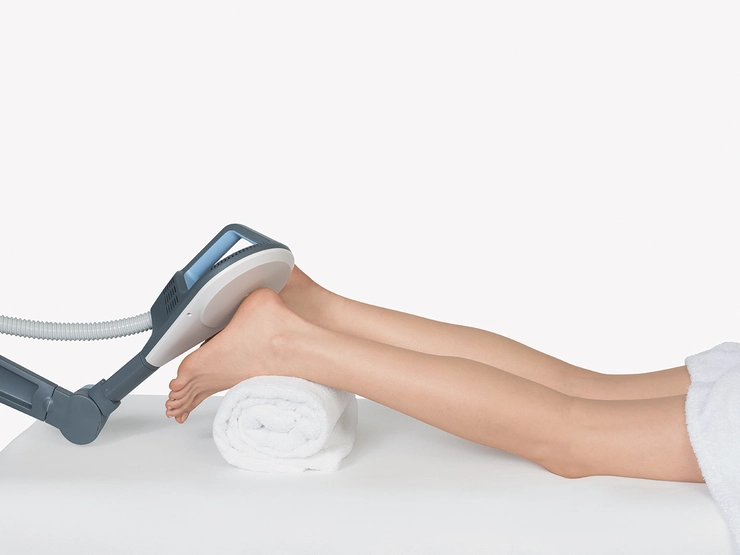
A pressurised air chamber can hold up a precise, dialable percentage of your bodyweight — anywhere from 1% to 100% — while you walk or run exactly as you normally would. For the first time, a clinician could turn gravity down instead of only turning resistance up.
From astronaut training to elite sport — and now, to a clinic you can actually walk into
This technology didn’t start in a hospital. It started with a very small, very specific group of people who needed to move normally in an environment with no gravity at all. From there it moved into the training rooms of professional sports teams and Olympic programmes, where the ability to run at a fraction of bodyweight — without changing stride length, foot strike, or cadence — became a genuine competitive advantage during injury recovery.
For most of its existence, that has been the whole story: extraordinary technology, available to an extraordinarily small number of people. At Movementology, we asked a different question — why should the tissue-healing biology of a professional athlete be the only biology that gets access to precision load control? The R-Force Zero Gravity Treadmill is now part of our standard rehabilitation toolkit in Bengaluru, available to anyone whose recovery needs exactly what it offers.
What it actually feels like — a 185kg patient, hopping
Here is the detail that tends to make people stop and pay attention. One of the clearest demonstrations of what this machine can do involves a patient who could barely stand under his own weight. At just 5% of his bodyweight, he was hopping and jumping on the treadmill — movements that would have been completely unthinkable for him on solid ground, days into his recovery rather than months.
That’s the entire point. Not that the treadmill makes rehabilitation easier — but that it makes tissue-appropriate movement possible at a stage of recovery when movement would otherwise simply not happen at all.
1–100%
Bodyweight can be precisely dialled in 1% increments — full offloading to full load, and everything in between.
The part that turns a treadmill into a diagnostic tool
What separates this from simply “a treadmill that makes you lighter” is what it watches while you move. An integrated wide-angle camera and real-time console track the mechanics of every stride as it happens — not just whether you can walk, but exactly how well.
What the console measures, in real time
- Gait rhythm
- Step length
- Step width
- Left–right symmetry
This is what makes it an Arthrorehab tool rather than just equipment in the corner of the gym. A clinician isn’t guessing whether your walk is improving — they’re watching your left and right sides load evenly in real time, and adjusting the programme accordingly, in the same session.
Precision, not one-size-fits-all: five different problems, five different dials
The unweighting percentage, speed, and incline are never generic. They’re set according to exactly what the tissue in front of us can currently tolerate — and that changes enormously depending on what we’re treating.
Acute post-surgical patients often begin around 60–65% offloading, at very low speed, for short sessions — enough movement to preserve gait patterning without threatening a healing repair.
Chronic conditions building endurance or strength progress toward roughly 45% offloading, with incline added specifically to load the tissue that needs to adapt.
Athletes returning to running typically train at a much lower offload — around 20% — where the goal has shifted from protecting tissue to rebuilding speed, endurance, and uphill capacity under near-normal load.
Older adults and patients managing weight follow entirely different protocols again, built around joint-friendly endurance rather than performance.
None of these numbers are arbitrary. They come from a structured protocol library, applied by a clinician who understands which dial to turn for which patient — which is the same criteria-based principle behind everything else in the Arthrorehab programme.
Real problems this has solved at Movementology
The technology is only as good as the complexity of the problems it’s used on. Here is a sample of what we’ve actually used it for — not hypothetical use cases, but real patients.
- Post-op total knee replacement
Rebuilding walking endurance, gait symmetry, and eventually uphill walking capacity — safely, from early in recovery. - Tibial condyle fracture
Restoring symmetrical loading through the healing bone while using movement itself as a healing stimulus, alongside weight management for optimal joint function. - Patellar fracture with grade 3 chondromalacia
Retraining single-leg loading and stair descent while working around significant cartilage damage and quadriceps inhibition. - Cervical myelopathy
Not an orthopaedic case at all — a neurological gait disorder, addressed by retraining step length and stride timing with precision most standard gait training can’t match. - Bone stress injury — fibula
Maintaining running endurance while precisely managing the load and intensity that a stress-reacting bone can currently tolerate. - Bone stress injury — navicular
One of the most notoriously slow-healing stress fractures in the foot, managed with the same intensity-controlled approach.
Notice how different these problems are from each other. A knee replacement, a fractured bone, a cartilage injury, and a neurological condition don’t share an anatomy — but they all share the same underlying clinical question: how much load can this tissue tolerate right now, and how do we deliver exactly that much, no more and no less? That question is what this machine was built to answer.
What the research shows
This isn’t an emerging or unproven approach — it has a growing evidence base behind it. Recent clinical research has found better gait quality and less muscle wasting in post-surgical patients trained this way compared with standard rehabilitation, meaningful improvements in gait symmetry after both knee and hip replacement surgery, measurable increases in metabolic rate during training, and improved running form and performance even in healthy volunteers.
A technology that was once reserved for astronauts and Olympic athletes is now part of a standard Movementology rehabilitation programme — used not as a novelty, but as a precise clinical tool for exactly the complex problems it was built to solve. If your recovery needs movement that your current tissue can’t yet handle on solid ground, this might be the missing piece.
Ask about zero-gravity training at Movementology
Frequently asked questions
- How much of my bodyweight can actually be taken off?
Anywhere from 1% to 100%, adjusted in precise 1% increments. That range is what makes it useful across such different situations — a patient just days out of surgery might train at 35–45% bodyweight, while an athlete rebuilding running speed might train at 80% bodyweight or more, with only a small amount of support. - Is this only for elite athletes?
No — that’s a common misconception, and understandably so, given where the technology started. At Movementology, it’s used across post-surgical recovery, bone stress injuries, cartilage damage, neurological gait conditions, weight management, and healthy ageing, alongside athletic return-to-sport work. The common thread isn’t the patient’s fitness level — it’s whether their tissue currently needs a controlled, reduced load to move safely. - How is this different from a normal treadmill or a pool-based exercise?
Unlike water-based unloading, it preserves normal gait mechanics — the same stride length, foot strike, and cadence you’d use on solid ground — while still reducing load precisely. And unlike a standard treadmill, the integrated camera and console give real-time feedback on gait rhythm, step length, step width, and left-right symmetry, so the clinician can see exactly how your movement quality is progressing, session by session. - What conditions is it used for at Movementology?
Post-surgical recovery (including knee replacement and ligament reconstruction), bone stress injuries, fractures, cartilage damage, neurological gait disorders, and structured return-to-running programmes for athletes. The specific unweighting percentage, speed, and incline are set according to a protocol matched to the condition and its current healing stage — never applied generically. - When would my rehabilitation programme include this?
Whenever your tissue needs to keep moving but can’t yet tolerate full bodyweight — often from very early in post-surgical or post-fracture recovery, through to the later stages of building back running capacity before return to sport. Your clinician will set the specific parameters based on where you are in your Arthrorehab programme, not a fixed calendar date.
Dr. Padmanabam Sekaran P.T
Chief Physiotherapist, Lead Consultant – Advanced Orthopedic Rehabilitation